
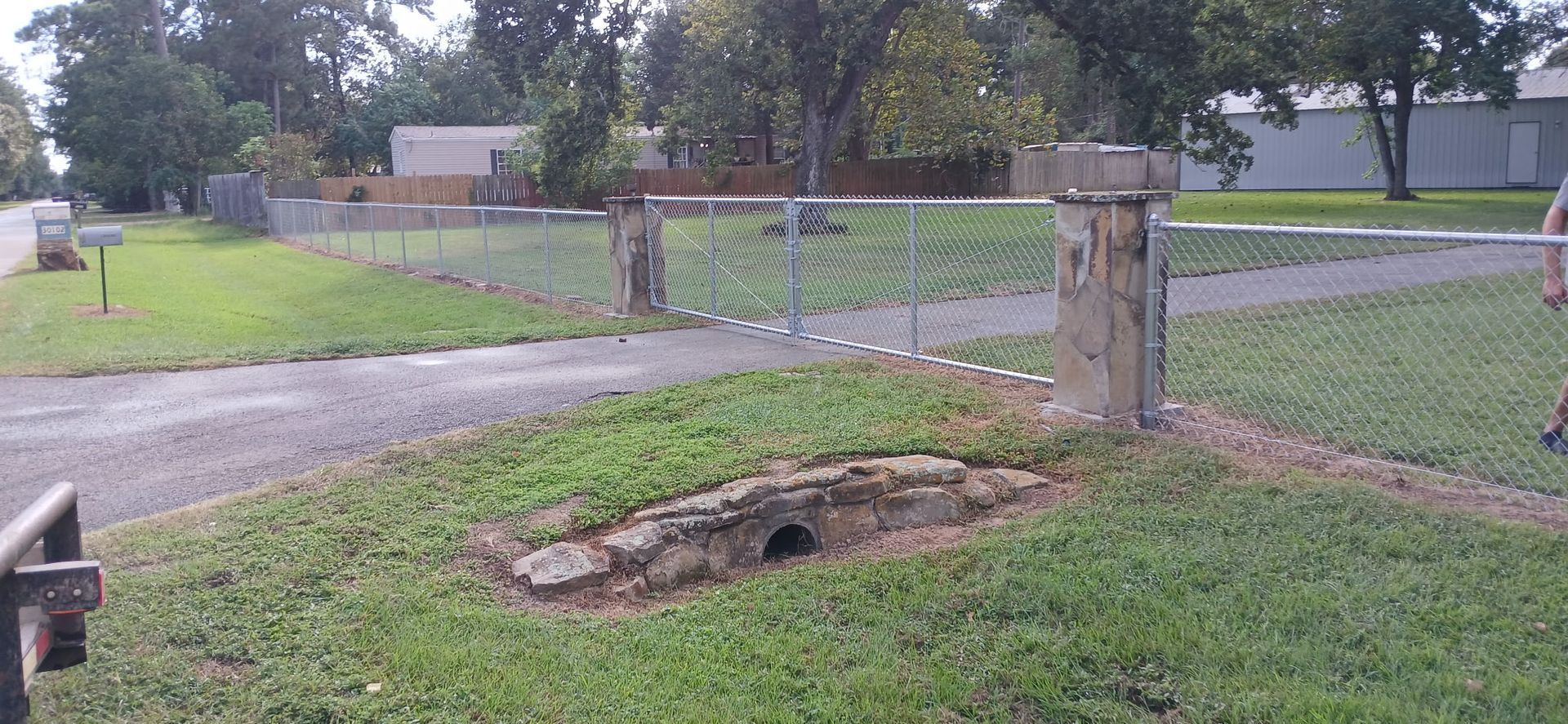
Drainage Corrections That Protect Foundations and Landscapes
Landscape drainage and grading in Splendora for properties where clay soil and afternoon storms are creating pooling, erosion, or water intrusion near structures
Heavy afternoon thunderstorms and clay-dominant soils across North Texas create a predictable drainage failure pattern: water that can't infiltrate the surface fast enough runs laterally, concentrating toward low points — often foundations, hardscape edges, or recently planted beds. Scott's Manicured Lawns diagnoses and corrects drainage and grading issues in Splendora and The Woodlands area, working from a site assessment that identifies whether surface grading, French drain installation, or swale regrading is the appropriate solution. Not every drainage problem requires pipe and excavation — the assessment determines what the site actually needs before any work is planned.
Improper grading around residential properties is one of the more consistent contributors to both foundation movement and landscape failure in this region. When finished grade slopes toward a structure rather than away from it, every rain event pushes water toward the foundation wall or slab edge — a condition that worsens as soil settles after construction and original grade compresses or shifts. Scott's Manicured Lawns addresses surface grading corrections and subsurface drainage installations as separate or combined solutions depending on what the site assessment reveals.
Schedule a site assessment to identify the source and path of drainage problems before any grading or installation work is planned.
How Drainage Assessment Determines the Right Correction
A drainage site assessment maps water entry points, flow paths, and accumulation zones to determine whether the problem is a grading issue, a soil infiltration issue, or a subsurface flow problem that surface grading alone won't address. French drains — perforated pipe set in gravel within a trench — intercept subsurface lateral water movement and redirect it to an appropriate outlet before it reaches a foundation or low point. Swale regrading creates a designed surface channel that moves water away from structures through a graded pathway, which is appropriate when surface volume is manageable and a clear outlet direction exists.
After grading or drainage installation is complete, the visible change is water moving through or away from the problem area rather than accumulating — zones that previously held standing water after rain drain within hours rather than days, and the erosion channels that formed from repeated storm runoff stop progressing. Landscape beds that were drowning from poor drainage begin supporting plant material as soil moisture stabilizes within the root zone.
Drainage work sometimes uncovers conditions that require coordination with other services — a French drain outlet needs a clear discharge point, and if the property's existing grade doesn't provide one, the solution may involve connecting to a curb, a swale, or a dry well depending on local regulations. Scott's Manicured Lawns evaluates discharge options as part of the drainage design rather than treating outlet location as an afterthought. Properties across Spring, The Woodlands, and Conroe vary significantly in terms of what discharge options are available and what local codes allow for residential drainage systems.
What Property Owners Ask About Drainage and Grading
Drainage questions typically involve how to identify whether the problem is surface-level or subsurface, and what realistic correction options exist for properties in North Texas with clay soil and limited natural grade.
What are visible signs that a property needs professional drainage correction?
Standing water that remains more than 24 hours after rain, erosion channels forming between planting beds, and soil pulling away from a foundation all indicate drainage failures that affect both landscape and structural integrity.
How does French drain installation address drainage problems that regrading alone cannot fix?
A French drain intercepts water moving laterally through the soil before it reaches a structure or low point — regrading the surface moves surface water, but subsurface lateral flow continues without the perforated pipe and gravel system underneath.
When should a drainage solution include both grading correction and subsurface drainage?
Properties where both the surface slope and subsurface lateral flow are misdirected — common in Splendora-area homes built on filled lots — typically need both solutions to address the full water movement pattern.
Why do drainage problems worsen after landscaping or hardscape is added to a property?
New planting beds, paver patios, or retaining walls change how and where water moves across the property — impervious cover additions increase runoff volume because water that previously absorbed through turf now moves across the surface at higher velocity.
What determines whether a swale or French drain is the right drainage solution?
Surface volume and soil conditions guide the decision — high-volume surface flow that moves predictably across open ground suits a swale, while subsurface lateral movement or areas with no clear surface outlet require French drain installation with a designed discharge point.
Scott's Manicured Lawns assesses drainage conditions and designs corrections based on what the site actually needs — arrange a property evaluation to identify water movement problems before they affect foundations, hardscape, or landscape investments.